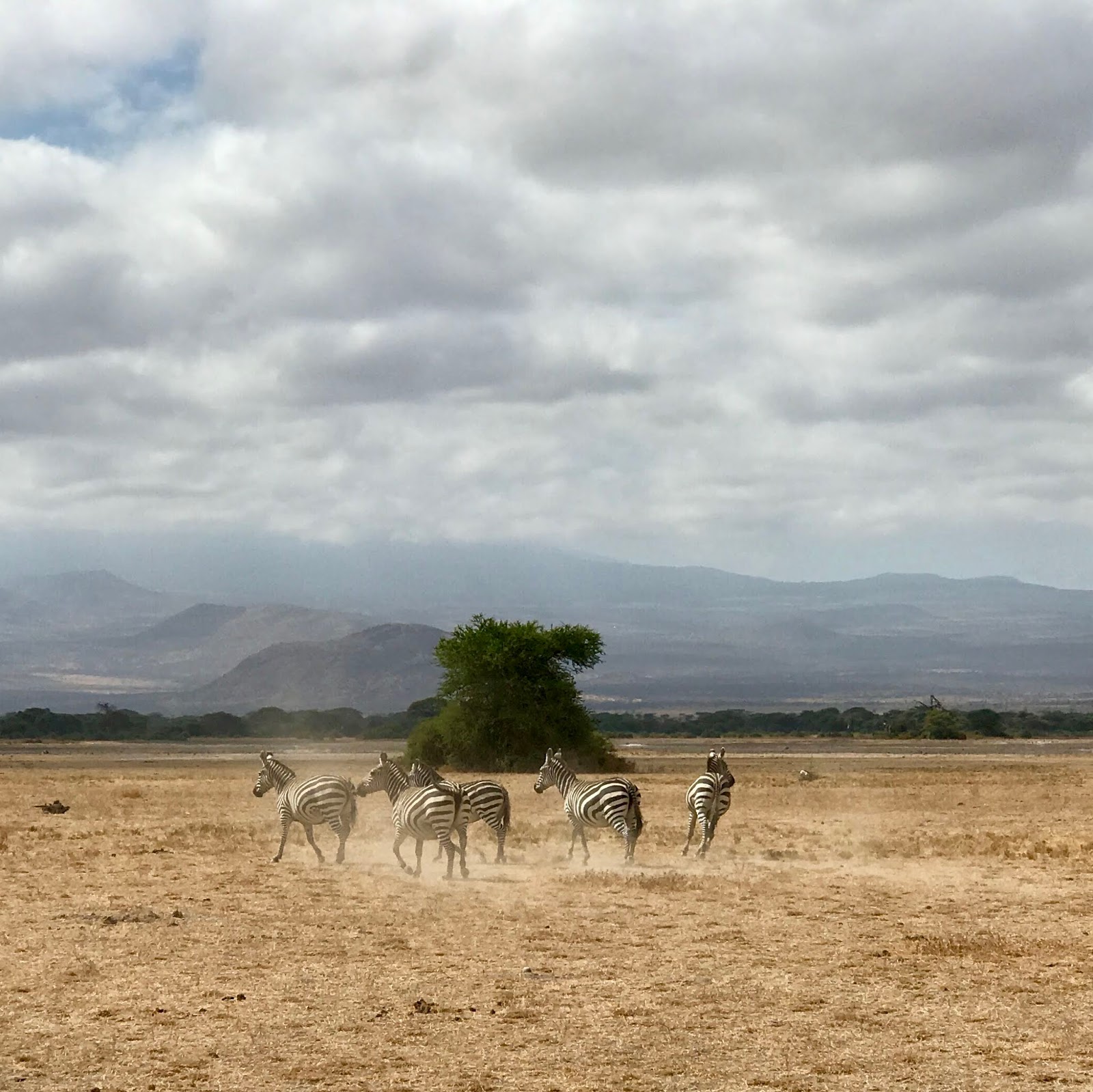
I came to Africa to see the animals,
but it is the encounters with the people that I will remember most.
I had no idea when we signed up for this OAT trip to Tanzania all that we'd see and do. Sure, the animals were the big draw. And the itinerary listed the OAT standard "A Day in the Life" experience and a visit to a school supported by the Grand Circle Foundation; but beyond that, I had no preconceptions or expectations.
Even after our first home visit, the ride in a tuk-tuk, and taste-testing local banana beer, I wasn't prepared for all the different opportunities for learning and discovery that awaited us every single day. For example: on Day 2 of the Hills of Kilimanjaro pre-trip, we were given the opportunity to visit a local medical clinic located near our tented camp. It was an optional, free time activity, so not all of us chose to partake. But I did, along with four others.
Along the way to the clinic I commented on three young girls I saw carrying large bundles of sticks on their backs. "Do you want to try that?" asked Lenny, our Trip Leader. "Of course," was my immediate and enthusiastic reply. This was the first "Stop the Land Cruiser" moment. (There would be more.)
View the following photos that tell the rest of the story.
This first photo was actually taken after I had tried carrying the load of firewood.
As you can see, each of the girls has a bottle of water as a 'gratuity' for allowing us to take pictures and engage with them.
This is/was an on-going personal concern about how to engage with the locals without 1. My feeling like a voyeur, and 2. Their feeling like an animal on display. To allay at least part of those concerns I assumed that the people involved in these 'Learning and Discovery' encounters were compensated, but I didn't know how and/or when.
 |
| Judging by their height, these girls are probably 8-10 years old. And despite their shaved heads, which to Western eyes may suggest they are boys, we learned that only girls gather wood. In fact, as we would later learn, girls and women do all of the labor intensive domestic work of maintaining a family/village. |
 |
Girls are often promised in marriage long before they are of age,
and according to our Trip Leader, they often wear a single white beaded necklace
as an indication that they have been spoken for.
Marrying girls in exchange for cows or money is still being practiced,
and Tanzania has one of the highest percentage of child brides in the world.
Almost two out of five girls in Tanzania are married before their 18th birthday.
|
Unlike the girls who take these bundles on and off by themselves, I needed the help of Lenny to lift mine up and onto my back.
I guessed the bundle itself to weigh about 30#, which equaled the weight of my safari duffel.
I knew could lift that, but getting this bundle of sticks onto my back
and the head strap across the top of my head proved more difficult that I imagined.
 |
| Look closely and you can see the girls giggling at my awkward attempt. |
 |
| Notice the machete stuck diagonally through the bundle of sticks. Not until later when I looked at this photo did I realize it was there. |
 |
| Oh My Goodness! This is really heavy! |
 |
| Walking proved difficult, too. I tried leaning forward to compensate for the weight on my back, but I am sure that after a few yards, my lower back would be screaming. And watching the girls, I could see they were able to stand pretty much erect. |
Even Sylvester, the Kambi Ya Tembo camp manager who served as our local guide today, took a turn at carrying a bundle.
There was definitely lots of Learning and Discovery going on!
 |
| Notice the machete now in my right hand. I'm ready to go to work. |
In addition to my own memory and notes I took, I used the following resources for the verification of facts and elaboration of content for the above section.
Next Stop--the Clinic
Or, so I thought. Before going to the clinic, we visited Olmoti Primary School which is part of the growing Olmoti Community Center. It was Sunday, so no students were present, but we did get a chance to meet the head teacher and see the school along with the second school building under construction.
 |
| Sylvester John, the manager of the Kambi Ya Tembo Lodge where we are staying, is also an important liaison/supporter of the clinic/school project. Here he explains the history of the school and the neighboring clinic. |
A more complete story of Olmoti School is best described in the words from their website which I include below.
Health and Education: A Winning Combination
In seeking to improve the heath and well-being of the Olmoti population, especially women and children, Olmoti Trust recognizes the importance of making education more accessible.
Inspired by the stories of local mothers who told Dr. Diane Raleigh in 2015 that they couldn't send their first-graders to school because the trek was too long and dangerous, Olmoti Trust built a two-room Olmoti Primary School.
The school, adding to the growing village center anchored by Olmoti Clinic and Health Center, and our staff housing, opened in July 2016. The district government has provided three teachers to meet our growing enrollment of 240 children in morning and afternoon shifts. The Maasai demonstrated their commitment not just by enrolling their children but by building the school’s latrines -- donating labor, money and valuable goats to the cause.
The school provides a crucial link for children who otherwise would miss key foundational education and fall behind their peers by the time they were big enough to walk to the nearest primary school.
Above text courtesy of https://www.olmoticlinic.org/olmoti-primary-school
In the photo below, don't be fooled by all the shaved heads that this is a school for boys only. Both girls and boys shave their heads, so its hard to tell in this picture who's who.Typically, in the school uniforms, girls wear skirts and boys wear pants, neither of which is visible in this photo.
 |
| Photo courtesy of https://www.olmoticlinic.org/olmoti-primary-school |
 |
| Stepping inside this empty room, I could only imagine what it must be like to teach and manage a roomful of 60-70 students, seated 3-4 to a desk. A classroom of more than 28 was considered overload when I taught middle school. |
 |
| What dreams might the children have as they gaze out these windows? |

 |
| A photo collage of teaching tools and student work |
 |
| Stacks of well-worn student composition books are stored in the teachers' office. |
The photo below is a formal picture of the teacher who we met during our impromptu visit. According to Sylvester, she chose to come to this school and stays on as a teacher year after year despite the minimal pay and its remote location because she is devoted to making a difference in the lives of the students she teaches. Apparently, in other schools in similarly remote areas, it is difficult to attract and to keep teachers. Clearly, she is an exception.
Photo courtesy of https://www.olmoticlinic.org/olmoti-primary-school

Finally, the Olmoti Clinic:
The Initial Purpose of this Optional Learning and Discovery Excursion
Mama Yaya is a Maasai midwife who, like her mother and grandmother before her, worked in this remote Olmoti region. And like her predecessors, she had a long-time dream of preventing the needless deaths of infants and mothers during childbirth. Then in 2009 she met two visiting American women, Diane Raleigh and Gloria Upchurch, who turned that dream into a reality by building a health clinic. And that was the start of something big.
For more complete information about this amazing story, follow this link to the Olmoti Clinic website: https://www.olmoticlinic.org/story
 |
| This is the newly constructed breezeway that leads from the health clinic to the new surgery and patient wards. |
 |
| The upper photo is the new surgery and the lower photo is the view looking from the surgery to the clinic. Note the solar panels and solar water heater on the roof. |
 |
| The top photo shows the lay of the land in this remote region of northern Tanzania. The small round huts with thatched roofs are the houses of the local Maasai people which are typically built of mud and cow dung. The lighter colored buildings made of cement blocks are houses for the medical and teaching staff and are part of this growing Community Center. |
 |
| One of several examination rooms in the clinic. |
 |
| Another patient examination room in the clinic. |
 |
| The lab in the clinic |
 |
| One of several two-patient rooms in the surgery center wards. |
 |
| The Health Center depends on non-profit organizations such as Vitamin Angels for many of their supplies. According to their Facebook page, Vitamin Angels is a non-profit organization that distributes lifesaving and life changing vitamins and minerals to children and mothers in need and has a Charity Navigator 4-star rating. https://www.vitaminangels.org/ |
The following is from the blog https://www.olmoticlinic.org/blog as posted on the Olmoti Clinic website. The photo and text provides an overview of the success of the clinic and the school. As witnessed during our visit in October 2018, the surgery facility and hospital wards are now open, and a second school building is under construction.
A Village Center Emerges
March 7, 2018
By Rita Beamish
The construction of our new Health Center, with surgery facilities and wards, has been truly exciting, and an aerial view shows just how dramatically our work has changed Olmoti. Where once there was only windswept scrub, a village center has emerged. The community uses our school and clinic for meetings and organizing as well as for health needs and to educate 240 children!
The photo shows the three new buildings (under construction in this photo, but completed since) and our Olmoti clinic forming a quad in the foreground. In the background are the medical staff housing, doctor's house, teachers' housing, and on the far right our primary school!

Since this photo was taken, we saw a second school building under construction to the left of the school which is on the far right in this photo.
As if this wasn't already enough Learning and Discovery, there still was one more encounter to meet a few of the local people before we returned to our camp for our late afternoon game drive.
But since I've gone on too long, I'll save that for my next blogpost.