Friday, November 9, 2018

MORE SIGHTS OF AMSTERDAM

Bicycles, Canals, Storefronts, Windows, Flowers & Whatnot

It is impossible for me to walk down any street without seeing dozens of scenes to capture. That's one reason I love my iPhone as I always have it with me, and I can shoot pretty much on the fly. If I'm with a group, I'm always the last one so I can get the shots I want without all the people. And when it's just Doug and me, he's always a block or two ahead of me because I keep stopping for 'just one more.' 

Many people say that taking pictures spoils being in the moment and simply enjoying what you see. It's just the opposite for me. I'm more engaged with my surroundings because I'm always looking above me, behind me, down the side alley, around the corner, or more closely to find that detail I might otherwise miss. 

Here are some of my favorite scenes that include many of my favorite photo subjects. Enjoy this last walk through Amsterdam because tomorrow we leave for Africa!

BICYCLES

Light and shadow play in a row of bikes along the canal behind the Flower Market

With so many bikes, some people want theirs to stand out.

As a cyclist myself, I love seeing all the different kinds of bikes.

Note the red pavement. That is the bicycle lane. Pedestrian beware if you are walking in the red lane.

A pink Gazelle. Is this a foreshadow of Africa?

An Amsterdam trifecta--bike, canal, flowers

A bicycle camouflaged by the flowers

A bicycle carrying flowers.

A tricycle passing flowers

A bicycle with a flowered seat

And a bicycle with a flower garland

A common sight

A helmeted motorcyclist passing by

Another Amsterdam trifecta--canal, bikes and reflections 

OUTDOOR CAFES

Red is my favorite color

Triple X represents Valor, Resolution, and Mercy OR
the three threats to the city--Water, Fire and Pestilence

Have a seat outside or in?

More red catches my eye

Your table is ready and waiting

Have a seat and enjoy the view

The name “in the monkeys” gives a hint to the legend and lore behind this bruincafe. (Brown cafe) The small bar located near the harbor was also an inn in the 17th century. Back in the day, sailors coming into town could spend the night here. Low on cash, they would trade their treasures for drinks and a place to rest their heads. As many of the sailors coming from overseas apparently had pet monkeys, the owner would take these monkeys as payment. Soon the place was full of these apes and their fleas.


In ‘t Aepjen is housed in one of Amsterdam’s oldest structures, built in 1519. The classic brick buildings you see all over Amsterdam were not always there; medieval Amsterdam was filled with wooden structures. Zeedijk 1 is one of the two wooden buildings still standing in Amsterdam.
Notice the monkeys everywhere. Carved wooden monkeys, monkey sculptures, monkey posters and monkey paintings.

STOREFRONTS AND WINDOW DRESSING

I don't know if this little bike is for sale or if it belongs to one of the store's patrons.

A blast from the past or a robot of the future?

How about some cheese, please.

Bike memorabilia for the tourist

With all of the bicycles, there's bound to be a lot of bike shops.
Here's an especially colorful one.

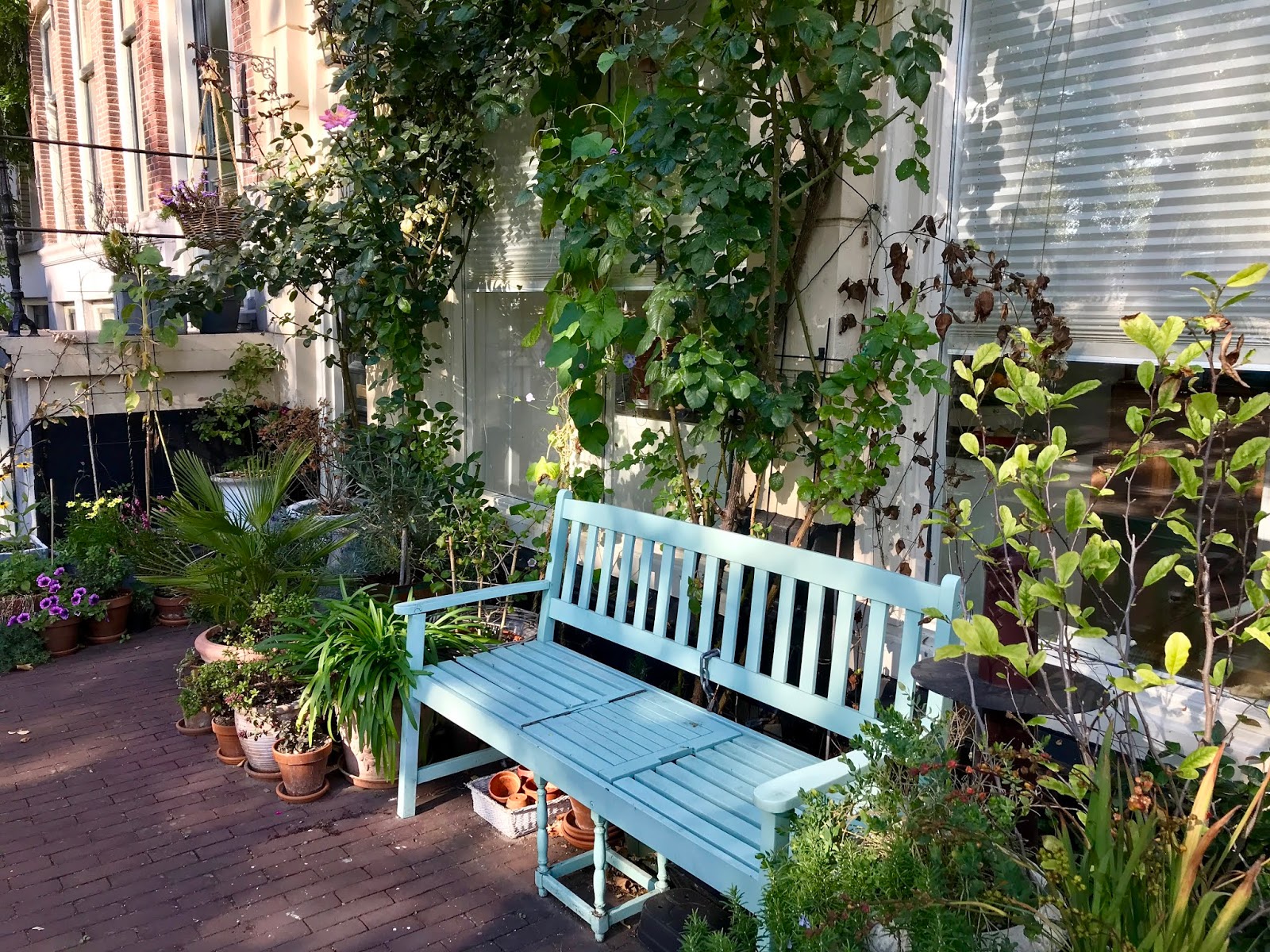
What's not to love about this scene?

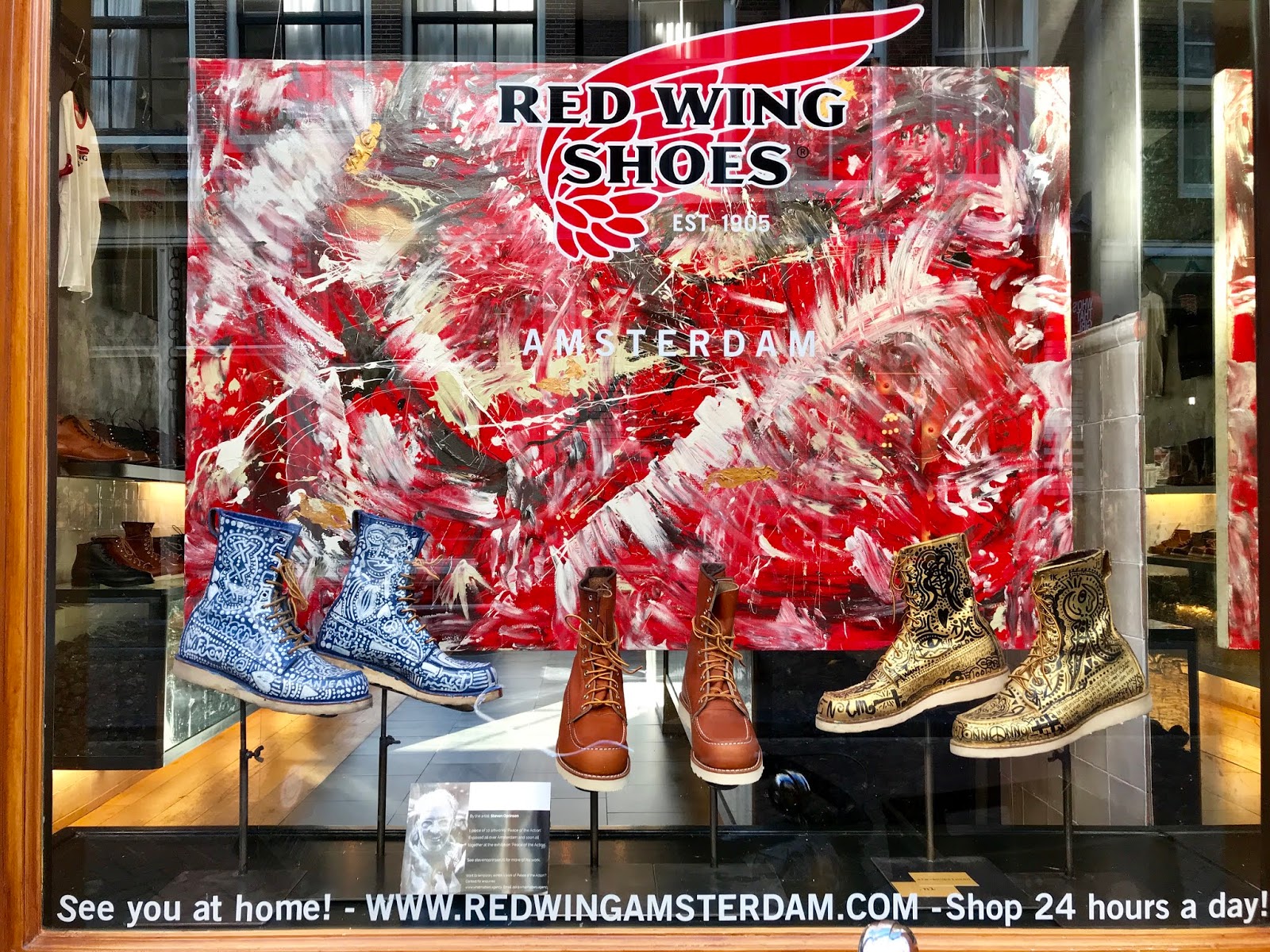
Certainly not my father's Red Wing store

Words of wisdom: You are either in your bed or in your shoes, so it pays to invest in both.

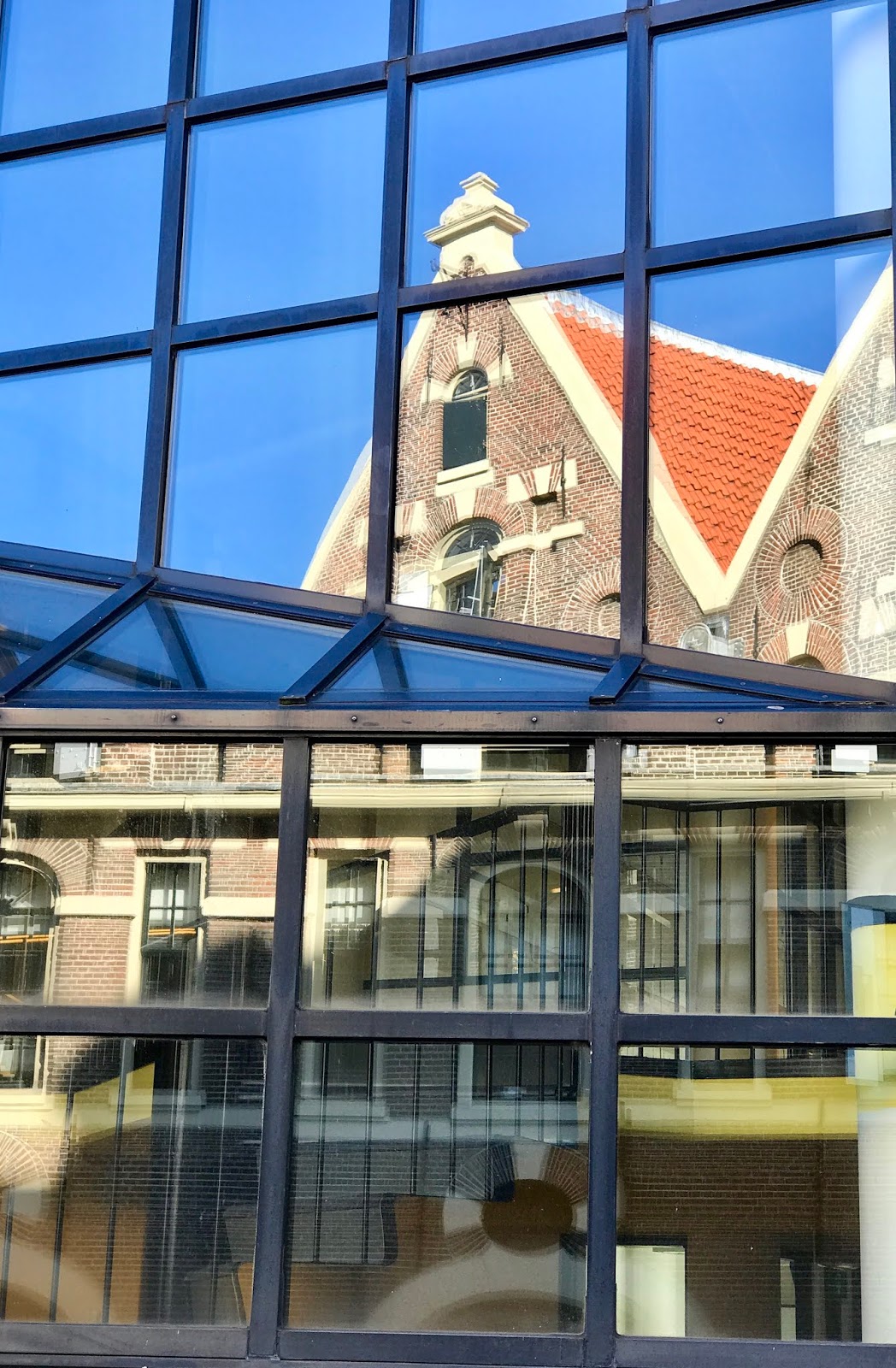
Flower shop reflections (There's more to this shot than meets the eye.)


How many monkeys can you see?

Are we in Africa, yet?

WINDOWS: FROM OUTSIDE IN

A beer tasting tavern

As seen on a houseboat

Geraniums, ironwork, reflections, Oh my!


AND WHATNOT. . .

Street artist at work

A door front still life

A classic Amsterdam scene

Even houseboat dwellers have a desire to grow things

Note the out of plumb buildings. This is typical everywhere.

Yours truly enjoying one of many pedi-cab rides.

BYE BYE AMSTERDAM; TANZANIA HERE WE COME!

Leaving Amsterdam

Flying over the north coast of Africa

Tuesday, November 6, 2018

AMSTERDAM HIGHLIGHTS CONTINUED-Canal Tour, Van Gogh Museum, Red Light District and . . . differing perspectives


Viewing Amsterdam from a boat in a canal gives one a different perspective on one's surroundings. So as an interlude between the Rijksmuseum and lunch and the Van Gogh museum, our tour du jour included a one-hour canal cruise. Ours was a basic canal cruise in a semi-open boat. 

But there are umpteen different canal cruises available depending upon the services offered. There are day time cruises and evening cruises, with some offering dinner and adult beverages. There are Hop-on Hop-off cruises, Burger Cruises, Pizza Cruises, Candlelight Cruises, and Watercolor Cruises. 
There are also semi-open boat cruises, small boat cruises, and Dutch authentic boat cruises. 

Obviously, there is a cruise for everyone, and my recommendation is to be sure to take at least one cruise to see Amsterdam from the water. Most cruises can be booked online in advance to avoid waiting in line. But with so many cruises offered, waiting until you get to Amsterdam probably works, too. 


We were told that shutters on the windows suggest that the building was a warehouse. Now I wonder if they aren't a design element on many of the refurbished houses. That said, however, as with other features on these old houses, when remodeling owners must not change authentic architectural elements since much of the old city is a designated World Heritage site. So in these refurbished houses, perhaps that's why the shutters are still there, even though the building may no longer be a warehouse.


Along our cruise we passed this four-story bicycle parking garage near Central Station. Only in Amsterdam where they have more bicycles than people and certainly more bicycles than cars.


Central Station almost looks small seen from the water. And if you think it looks a lot like the Rikjksmuseum, you aren't seeing things. Both buildings were designed by the same architect, Pierre Cuypers, with a Gothic/Renaissance Revival facade.  

As an aside, the land where Central Station sits was once all water. According to our guide (and Wikipedia) the station is built on three interconnected artificial islands. These islands were created with sand taken from the dunes near Velsen, which had become available as a result of the excavation of the North Sea Canal. The islands together are known as Stationseiland (Station Island). Like many other structures in Amsterdam, the station was built on wooden piles (8,687 pieces). The construction of the station was delayed because of the instability of the soil, which set back the completion of the work by several years.


Along the canal we passed many houseboats and live-in barges. In fact there are over 3000 registered boat houses, but no new licenses are being granted. Originally, the boats themselves were relatively inexpensive to purchase and renovate. However, the big expense came with rising costs to rent or purchase moorage along a canal. Like today's mobile homes and tiny homes, the space to park one's home often is valued much higher than the residence itself.

I particularly like the houseboat on the left because of the clothesline with laundry hanging. That's because another one of my favorite photo subjects is hanging laundry; so this shots fits the bill.


When I saw this building come into view, I knew I had to get a shot. That's because I had pre-purchased tickets for the Museum of Bags and Purses for our return visit to Amsterdam. So now I knew where it was located. 

Also, notice the electric car plugged in. Many cars are electric in Amsterdam, and in fact, all the taxi cabs we rode in from the airport and back were electric along with a UPS truck I saw one day. And by 2025, all cars will be banned from parts of the city, making the areas exclusively for bicyclists and pedestrians. The city is already blocking off certain streets as we and our driver found out on our last taxi ride from our hotel to the airport.


As I stated in a previous blog, bicycles are the kings and queens of the road. They drive along the red-paved or painted streets and have right of way over cars and pedestrians. In certain parts of the city, electric trams also run, and pedestrians must be vigilant about those, too. Amazingly, I saw no bicycle/pedestrian/vehicle accidents in our six days in Amsterdam. Also, cyclists are not required to wear helmets because from most peoples' perspective, bicycles should not be dangerous.


After our canal cruise, we walked back to the museum district to see the Van Gogh museum. But because photos are not allowed inside the museum, I took this picture of Vincent as seen on the side of a bus to remember our visit.


The Damrak is an avenue and partially filled in canal at the center of Amsterdam, running between Amsterdam Central Station in the north and Dam Square in the south. It is the main street where people arriving at the station enter the center of Amsterdam. 

From street-side it offers a beautiful view of typical row houses reflected in the canal. This photo was taken in late afternoon with the setting sun.


Here is the same row of houses from a slightly different perspective and time of day with the lights being reflected in the canal. This was near the Barbizon Palace, our first hotel, so we passed it often. On this night we were gathering on the bridge for our Red Light District walking tour.


Here our guide Jose is introducing himself and briefing us on the rules of taking pictures in the Red Light District. He is the third person in from the left. The guy in orange is Doug.


The canals come alive with color at night, especially in De Wallen or the Red Light District with so many cafes, coffee shops, night clubs and restaurants.

Amsterdam prides itself on its wholly liberal and tolerant attitude, embracing the fact that people may be into prostitution, soft drugs and pornography. And that it is only human. So instead of criminalizing everything, they enjoy the honesty of it all. In other words, it's all about one's perspective.


The name "Red Light District" comes from the red neon lights that highlight the 300 windows where women work. Window prostitution is what it's called because scantily clad women stand behind glass windows advertising their services. It is strictly forbidden to take photos of the women, although this photo of the curtained windows was okay.

According to our guide, 80% of the women are from Eastern Europe. There are few Black, Asian or Latina prostitutes. The women work for themselves and pay taxes on their earnings, but also receive healthcare benefits from the government. The basic sex service costs 50 Euros for 15 minutes. It involves no touching, no kissing or no caressing, also known as "girlfriend" services which cost extra and must be negotiated in advance. 


This statue titled "Belle," of a prostitute standing proudly in the doorway of her place of business, honors the sex workers of the world. It was placed in the heart of the Amsterdam Red Light District in 2007. The project was conceived by Mariska Majoor, a former sex worker herself, who founded the Prostitute Information Centre in Amsterdam in 1994. After she retired, she decided to open the center to educate the public on sex work and to reduce the stigma faced by sex workers. 
In short, she is trying to change peoples' persepctive about sex workers.


Another campaign that is taking hold in the Red Light District is known as "I live here." While window prostitution and the associated businesses may be the big attraction at night, many other people live and work in De Wallen during the day. They grew tired of visitors peeing in their flower boxes, vomiting in their doorways, and basically disrespecting the residents; so they took action. 

The purpose of this campaign is to make visitors more aware that there are also people living in the Red Light District. Many visitors do not know that people live there, but experience shows that they adjust their behavior if they are actively pointed out. So people can change their persepctive if provided accurate information.


HIGHLIGHTS of AMSTERDAM: Rijksmuseum, Red Light District, Canal Tour & More

It only took one day for us to acclimate to the time and geographic changes, and then we were off being tourists in this great city. Follow along with these photos of the highlights of Days 2 and 3 in Amsterdam.

"We learn from history that we learn nothing from history." 
-George Bernard Shaw 

Visiting the Anne Frank House was high on my list of must-sees. I purchased the tickets online two months to the day in advance of our visit, which apparently is how it is done. Thank goodness it wasn't high tourist season as I am told the tickets go quickly.

The museum is the reconstruction of the canal house where Anne Frank and her family hid for two years in the Secret Annex before being discovered and deported to the concentration/extermination camp where every member of her family but her father Otto Frank died. The reconstructed facade of the building is unremarkable and, I assume, is sheathed in glass to protect it since it houses the significant history of the Frank family. As a result, the reflected image of the Dutch Reformed Westerkerk Church opposite the museum entrance is what is visible in this photo.

Seeing the bedroom walls, diaries, and the few keepsakes of Anne Frank and her family was a sobering experience, especially considering the current events in the world. No cameras were allowed inside the museum, hence this is my only photographic remembrance.


A block away in a small park we discovered this humble statue of Anne Frank. 


“History has remembered the kings and warriors, because they destroyed. Art has remembered the people, because they created” 
– William Morris

“Art is the signature of civilizations” 
– Beverley Sills

The Rijksmuseum was also a must-see and was part of a day-long Skip the Line group tour that also included the Van Gogh museum, a one-hour canal cruise and lunch.  

The building of the Rijksmuseum was designed by Pierre Cuypers and opened in 1885. It consists of two squares with an atrium in each centre. In the central axis is a tunnel with the entrances at ground level. As our guide told us, it is the only art museum in the world with a bicycle lane running through the middle of it.

The collection of the Rijksmuseum consists of 1 million objects and is dedicated to arts, crafts, and history from the years 1200 to 2000. Around 800 objects are currently on display in the museum.

The collection contains more than 2000 paintings from the Dutch Golden Age by notable painters such as Jacob van Ruisdael, Frans Hals, Johannes Vermeer, Jan Steen, Rembrandt, and Rembrandt's pupils.


The entrance to the museum is on the ground level. Visitors enter into a covered atrium with a glass ceiling. The vertical panels in the photo below are for sound abatement as the space can become very crowded with people.


Being a retired teacher, I am always drawn to groups of children when I travel. These kids really stood out with their colorful hats designed as the hair in many of the people in Rembrandt's paintings, but ultimately for the teachers to keep track of the students in the different groups.


Rembrandt's most famous painting, The Night Watch, is housed in the Night Watch Room at the end of the Hall of Fame.


An interesting side note is that at one time, all the painted details on the walls, columns, and ceilings were at one time painted over in white. It wasn't until the major renovation which began in 2003 and lasted 10 years that the painted details were meticulously repainted by dedicated art students at times lying on their backs, much like the original artists must have worked.


Much like the Mona Lisa in the Louvre and other iconic paintings elsewhere, there is always a crowd of people admiring The Night Watch. Today's crowd was actually few in number according to our guide who purposely made a bee line to this painting before more people arrived later in the morning.


And how fortunate are these students to sit with their teacher in front of a Rembrandt masterpiece to learn about the artist and the history? It took me 50+ years to see this painting in person after learning about it first in Art History 101 as a college student.


Among the 800 objects on display, this artist's paint box c. 1640-1660 caught my attention. The drawers of this small paint box are full of pots, bottles and bowls with the remains of pigments. However, in reading the description, I learned that rather than being used by an artist, it is more likely to have been a charming eye-catching object in an artist's studio. It certainly caught my eye!


Another eye catching display were these woolen caps worn by Dutch whalers. They were discovered in 1980 when archaeologists investigated the graves of 185 Dutchmen. Many skeletons were still wearing their knitted woolen head coverings. According to the description, these caps were highly personal and the men wearing them were recognizable by the specific colors and patterns of their caps. Presumably this is why the caps went with them into their graves.


I also liked this painting of the Amsterdam Town Hall (now the Royal Palace) on Dam Square. This building is considered the most important historical and cultural monument of the Dutch Golden Age as it represents the historical growth and development of the city during the 17th century.


The Rijksmuseum owns approximately 7250 ceramic objects, subdivided into porcelain (more than 4600 pieces), majolica (app. 400), faience (app. 1750) and stoneware (app. 850). The difference between these types of earthenware has to do with the material they are made of, or manner of production. 


The Rijksmuseum Research Library is part of the Rijksmuseum, and is the best and the largest public art history research library in The Netherlands.


Despite there being a Van Gogh museum down the street, the Rijksmuseum also owns several of his paintings. Van Gogh was not a stranger to the museum, having lived in Amsterdam 1977-1878. He also visited the museum in 1885 after it opened in its present location because he wished to see the works of Frans Hals and Rembrandt van Rijn again. 

This is one of several self-portraits painted after Van Gogh moved to Paris in 1886 utilizing the new, colorful style of French painters at the time. According to sources, he practiced new painting techniques in self-portraits to avoid having to pay for a model.


This painting, Two Young Women in the Snow, was a favorite of mine. The artist, Isaac Israels, was a Dutch painter associated with the Dutch Impressionism movement. I think I was drawn to this painting by the generous use of red and the setting in the snow, According to sources, it is of an everyday scene in Amsterdam in the winter. Two warmly dressed women appear as if they had momentarily stopped right before the painter. 

However, critics claim that the scene is carefully considered, and the black and red passages of their shawls and coats are contrasted to create a well-balanced composition. Whatever the reason, I like it. 

I also was drawn to this painting by Dutch painter Willem Witsen. It reminded me of the hundreds of scenes I am drawn to of the houses, windows and doors throughout Amsterdam. Reading the description of this painting, it succinctly put into words what many of my photographs are attempting to do. I just didn't have the words to explain it.


By the time we left the Rijksmuseum after lunch, the sun was at an angle that created a wonderful play of light and shadows in the atrium. 


Next, it was on to the Canal Cruise before visiting the Van Gogh museum. Photos and narrative will continue in a new blogpost.